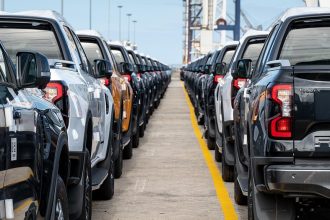
South Africa’s automotive industry has managed to weather the impact of US President Donald Trump’s steep tariffs, but concerns are rising as new trade challenges loom. While vehicle exports have increased by 2.5% year-to-date compared to 2024, the sector is feeling the strain of ongoing tariff uncertainty, particularly with a new 30% tariff set to come into effect on August 7, 2025.
The 25% tariff on South African vehicle exports to the US, which was implemented in April, has been a significant blow to the sector. Prior to the tariff imposition, South African goods benefited from duty-free access to the US market under the African Growth and Opportunity Act (Agoa). Despite this setback, the country’s automotive sector has displayed remarkable resilience, bolstered by supply-chain adjustments and the diversification of export markets.
According to the Automotive Business Council (Naamsa), South Africa’s automotive sector has shown remarkable adaptability, with a slight increase in vehicle exports despite the tariff imposition. Naamsa CEO Mikel Mabasa pointed out that while the current trade environment presents challenges, the sector’s ability to maintain solid export volumes proves the commitment of local original equipment manufacturers (OEMs) to the country’s industrial base.
“The automotive industry has long relied on export strength to drive production, attract investment, and create high-value employment. The current environment has tested that model, but our resilience and ability to maintain solid export figures amid escalating trade uncertainty show that we remain committed to South Africa’s industrial growth,” Mabasa said.
The country’s automotive exports have also expanded globally, with South African vehicles reaching 109 international markets by 2024. This diversification, along with longstanding trade relationships, has helped cushion the blow from tariff increases, allowing the sector to tap into new markets.
Despite the overall positive export performance, July’s export figures saw a small dip. Exports fell by 1.9% to 35,379 units compared to the same month in 2024. Naamsa attributed this decrease to mounting pressure from other export-oriented nations, which are now redirecting their vehicle volumes toward South Africa’s established markets.
“We are seeing increasing competition from other countries that are vying for the same export markets, and this is adding pressure to South Africa’s automotive sector,” Naamsa said. The situation is expected to worsen as the new 30% tariff on vehicles entering the US comes into effect.
The upcoming tariff hike is expected to place even more strain on South Africa’s vehicle manufacturing industry, which has already seen a dramatic 82% drop in exports to the US in the first half of 2025 compared to the same period in 2024. The US remains South Africa’s second-largest trading partner, behind China, and traditionally serves as a key destination for premium vehicles produced locally. However, without preferential tariff treatment from the US, South African vehicles are becoming less competitive in comparison to those from other countries that have successfully negotiated trade deals.
Busi Mavuso, CEO of Business Leadership South Africa, highlighted the risks that South Africa’s automotive industry faces, particularly in the Eastern Cape region, where the sector is a major source of employment. She stressed the urgency of effective interventions to prevent further job losses.
In response to the growing pressure, the Department of Trade, Industry & Competition (DTIC) has announced a series of emergency measures aimed at mitigating the impact of the tariff increase. Among these is the establishment of an export service desk to help businesses access alternative markets and manage the fallout from the tariffs. The desk will offer guidance on market entry processes, compliance requirements, and assist with linking exporters to South African embassies and high commissions abroad.
Despite these efforts, Naamsa’s Mabasa emphasized that continued cooperation with the government would be key to ensuring the sector’s long-term stability. He pointed to deepening regional trade relations, expanding market access in Africa and Asia, and accelerating the rollout of South Africa’s new energy vehicle transition strategy as vital steps to safeguard the future of the industry.
Mavuso also urged for the creation of a trade crisis committee, consisting of business leaders and government officials from key departments, to address the ongoing challenges. This committee would ensure rapid information flow and coordinated efforts between the public and private sectors.
“I encourage the president to establish a trade crisis committee that brings together business leaders and key government officials to jointly chart a path forward. This committee must include the National Treasury,” Mavuso said. “We already have proven crisis response tools developed during the Covid-19 pandemic and the 2021 unrest. These can be adapted to address our current trade challenges.”
While South Africa’s automotive sector remains resilient in the face of escalating trade uncertainty, the coming months will be crucial. With new tariffs looming and increased competition from other nations, the industry will need to rely on its ability to diversify export markets and adapt to an ever-evolving global trade landscape.
For now, South Africa’s automotive industry is navigating a stormy period, but the collective efforts of government, business, and industry leaders will be essential in ensuring its long-term survival and growth.
Main Image: Medium