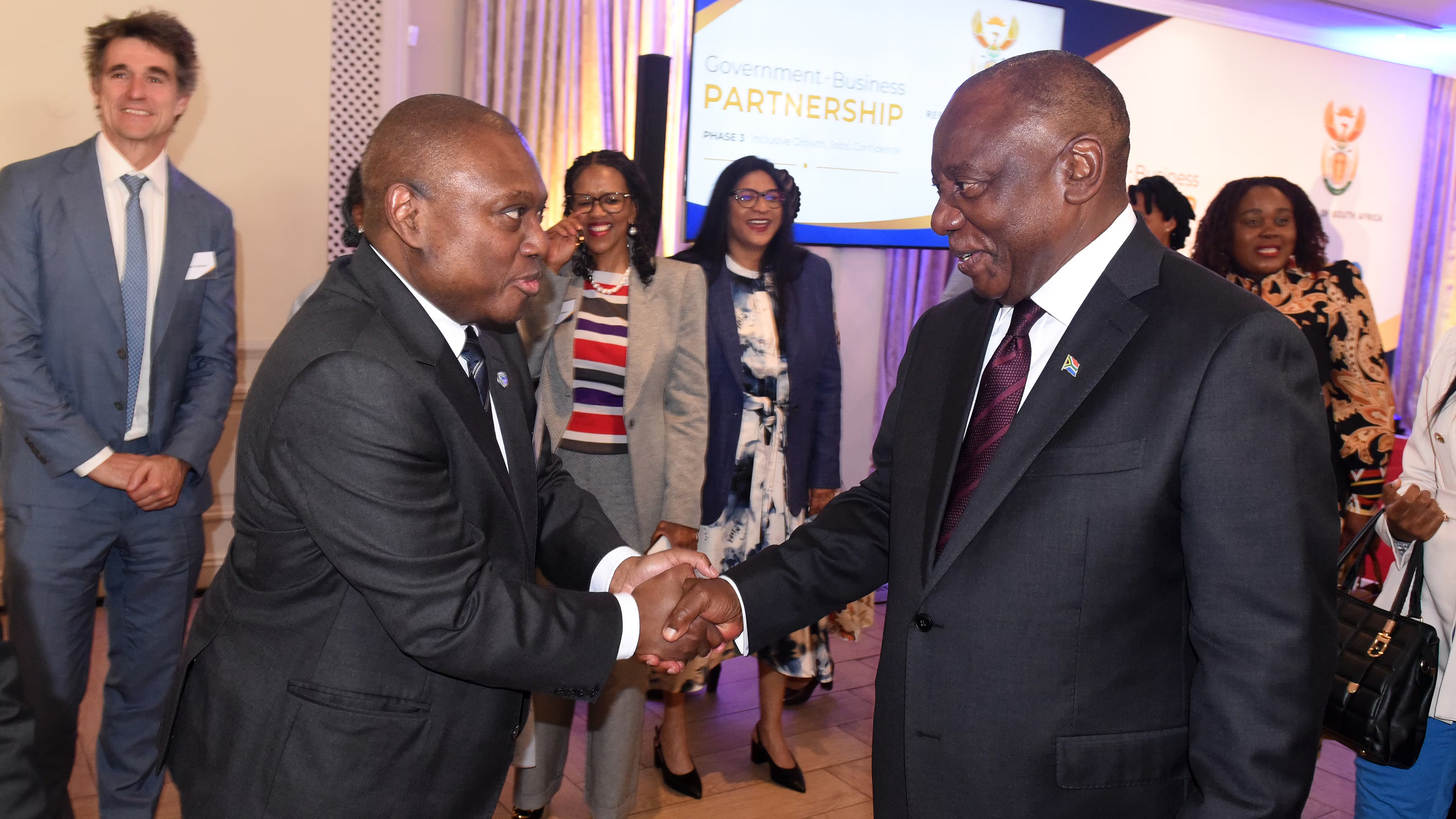
South Africa has entered the third phase of its Government-Business Partnership for Growth and Jobs, with President Cyril Ramaphosa setting an ambitious target of lifting economic growth to 3% by 2030 and creating one million jobs.
The latest phase places mining, tourism, infrastructure, agriculture and agro-processing at the centre of efforts to unlock investment and accelerate economic growth.
The Minerals Council South Africa has welcomed the initiative, saying mining has a major role to play in driving investment, employment and economic development.
A key priority is unlocking R50 billion in capital already committed to planned projects but currently held back by administrative delays, regulatory complexity and other constraints.
Mining takes centre stage
Minerals Council South Africa president Paul Dunne said the inclusion of mining in the third phase recognises the sector’s ability to generate economic activity and create jobs.
CEO Mzila Mthenjane said the partnership also signals renewed confidence in the progress made in areas such as electricity and logistics reform, while highlighting the sector’s long-term potential amid rising global demand for minerals.
He said mining could deliver significant benefits to South Africans over the next two to three decades, particularly as demand for minerals used in technology and infrastructure continues to grow.
Senior executive Shamini Harrington described mining as one of South Africa’s biggest opportunities for future growth.
“With rising global demand for critical minerals, the moment is definitely now,” she said, adding that closer cooperation between government and industry could help remove barriers, restore investor confidence and turn the country’s mineral wealth into economic growth.
Unlocking R50 billion
Minerals Council vice-president Dr Richard Stewart highlighted the R50 billion in planned domestic capital that could be unlocked if administrative and regulatory bottlenecks are addressed.
He said improving South Africa’s competitiveness as a mining destination could also attract additional foreign investment.
The partnership’s third phase will therefore focus heavily on implementation, with government and business expected to set measurable targets, establish timelines and hold leaders accountable for delivery.
Three pillars for economic growth
The new phase is structured around three broad pillars.
The first focuses on economic growth enablers, particularly energy and transport and logistics.
The second targets four growth sectors: mining, tourism, infrastructure, and agriculture and agro-processing.
The third focuses on confidence-building measures, including tackling crime and corruption, strengthening local government, supporting youth employment and improving South Africa’s economic narrative.
Youth employment will also remain a cross-cutting priority across the various workstreams.
Growth remains the biggest challenge
The push comes as South Africa continues to struggle with unemployment and sluggish economic growth.
Around 8.5 million people are without work, while approximately 300,000 new job-seekers enter the labour market each year.
Business Leadership South Africa chairperson and partnership co-convenor Adrian Gore said growth needs to move above 3% if South Africa is to create jobs at the scale required.
“Growth is essential for large-scale job creation,” Gore said, stressing that business is prepared to contribute leadership, expertise, implementation capacity and investment support.
Ramaphosa said the partnership has evolved from addressing immediate crises to building a platform for “growth and shared prosperity”.
The President emphasised that the next phase must focus on execution, transparency and accountability, with policies that unnecessarily block investment reviewed and institutional weaknesses addressed.
Detailed delivery plans and performance measures for each workstream are expected to be announced in the fourth quarter of 2026.
Main Image: Business Day