South African motorists are not legally required to give way to vehicles displaying white flashing lights—especially those used without proper authorization. Despite this, there’s a growing trend of private motorists fitting white strobe lights to their vehicles in a bid to bypass traffic, often misleading others into thinking they have emergency clearance.
In recent weeks, MyBroadband has observed a noticeable uptick in unmarked cars—typically private vehicles—using white strobing lights placed between their dashboards and windscreens. These drivers often speed down major highways and aggressively flash high beams at other motorists to force them out of the way. Many road users comply, mistakenly believing these vehicles have special privileges.
However, these vehicles often bear no official insignia or government plates that would indicate affiliation with law enforcement, emergency services, or diplomatic entities.
According to Rob Handfield-Jones, managing director of Driving.co.za, the misuse of white flashing lights by private individuals is becoming a serious issue. He points out that such installations are only legal under strict conditions outlined in the National Road Traffic Act.
The law permits only registered security service providers—specifically those recognized under the Security Officers Act of 1987—to use white flashing lights. Even then, the lights must comply with stringent technical and positioning requirements:
Lights must be non-rotating, non-strobing, and emit a diffused intermittent white light.
The vehicle must display the word “Security” illuminated by a white light.
The owner’s name must be clearly printed in black letters.
Lights must be mounted symmetrically, near the vehicle’s outer edges, and visible from both the front and rear within specified angles.
Placing white lights loosely on the dashboard does not meet these criteria. In fact, such positioning is explicitly non-compliant, as the lights are not visible from all required angles—particularly from behind the vehicle.
One suspected reason for this placement is ease of concealment. Motorists may quickly remove or hide the lights when approaching a police checkpoint or roadblock.
Handfield-Jones emphasized that motorists are under no legal obligation to yield to vehicles using white lights—whether the lights are installed legally or not. That courtesy remains voluntary, though some may choose to give way out of respect for the private security sector’s role in crime prevention.
However, only certain types of flashing lights carry legal authority on South African roads:
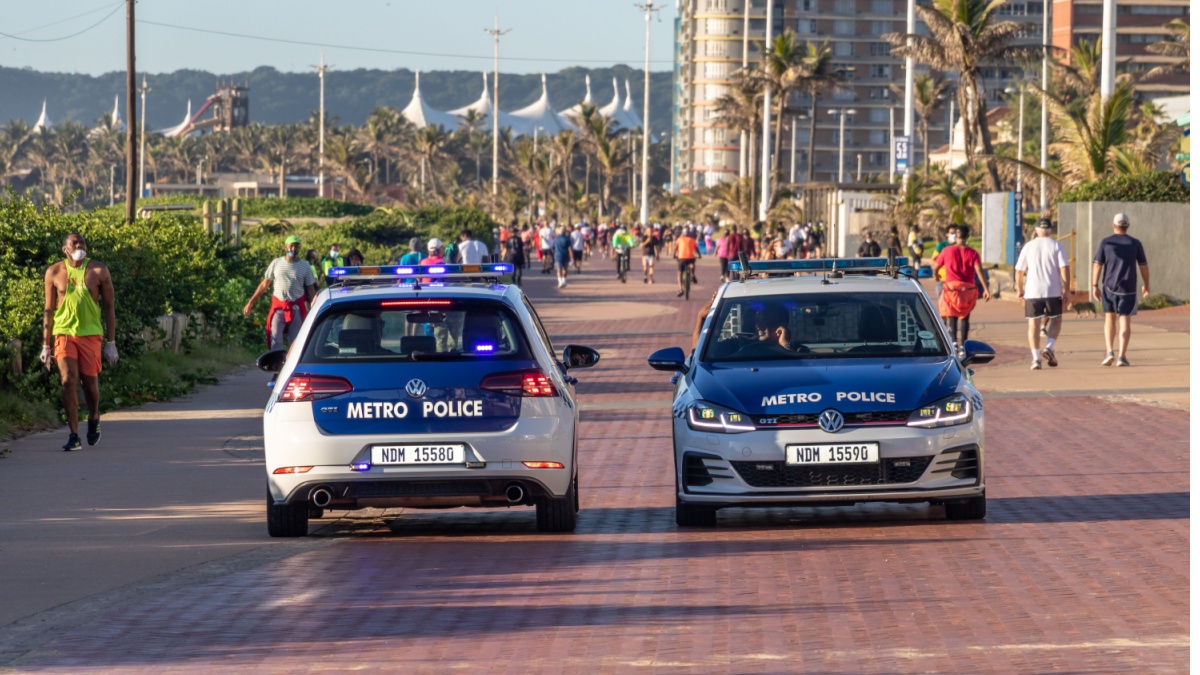
Blue lights: Used by the South African Police Service, metro and traffic police, and the military when assisting in law enforcement.
Red lights: Reserved for ambulances, fire engines, and rescue vehicles.
Green lights: Designated for disaster management units.
These vehicles are also equipped with audible sirens, which further distinguish them as emergency responders. Private citizens and security vehicles are not permitted to install sirens.
VIP protection units transporting government officials may use blue lights as they are officially part of the South African Police Service. When approached by these vehicles, drivers are legally required to make way—when it’s safe to do so—just as they would for police cars.
The Private Security Industry Regulatory Authority (Psira) recently reiterated that private security companies may only use white identification lights, and these may not be strobing or rotating. Use of blue, green, or yellow lights by private security vehicles is strictly prohibited.
The agency’s warning followed numerous public complaints, including calls for authorities to clamp down on taxi association patrol units that have begun using orange, yellow, and strobing lights, further confusing motorists and violating road traffic regulations.
Main Image: MyBroadband