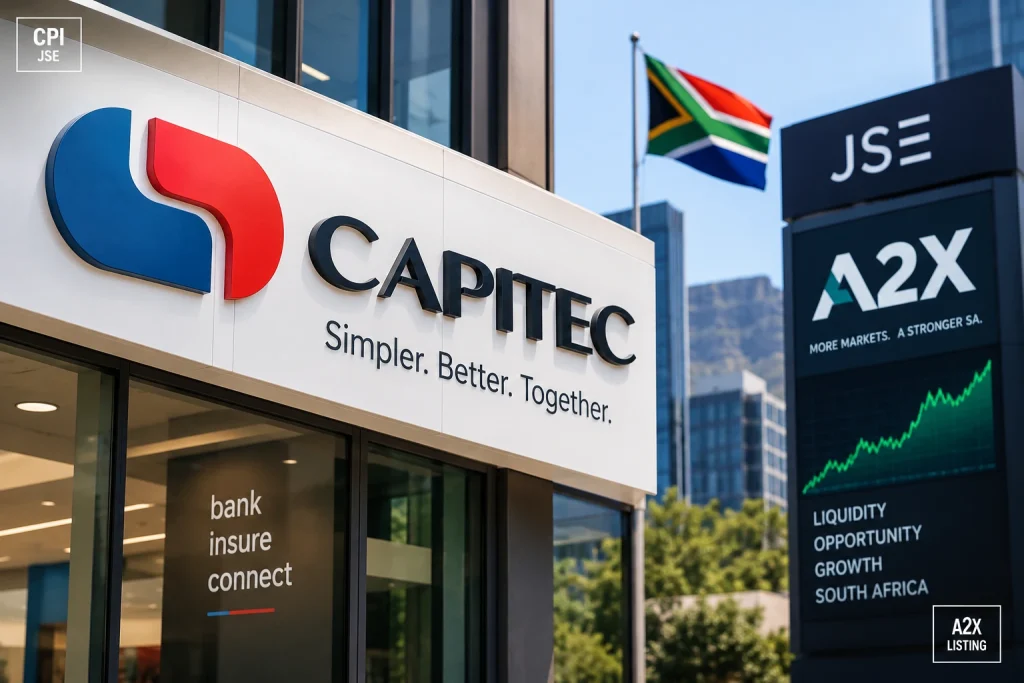
Capitec is set to add a secondary listing on A2X Markets next week, giving investors another regulated platform on which to trade shares in South Africa’s largest retail bank.
The move will not replace Capitec’s existing primary listing on the Johannesburg Stock Exchange (JSE). Instead, the bank will maintain its JSE listing while making its shares available on A2X.
With a market value of around R532 billion, Capitec’s arrival is a significant addition to the alternative exchange.
Another Platform For Investors
Capitec says the secondary listing is aimed at broadening investor access while supporting liquidity in its shares.
Chief Financial Officer Grant Hardy said the move supports the bank’s commitment to creating value for shareholders by providing an additional trading venue.
A2X Markets launched in 2017 and operates as a licensed stock exchange, allowing companies to have secondary listings and giving investors another regulated venue through which to trade shares.
The exchange currently has more than 160 securities and instruments listed.
Capitec will join several other major South African banking groups that already have secondary listings on A2X, including Absa, Investec, Nedbank and Standard Bank.
The listing comes as Capitec continues to report strong financial and customer growth.
For the financial year ended February 2026, the bank reported a 23% increase in headline earnings to R16.8 billion, while its return on equity climbed to 31%.
Capitec had R263.3 billion in assets at the end of the financial year and employed 17,672 people across 885 branches.
Its active customer base stood at 25.8 million at the end of February and has since passed the 26-million mark.
The bank is also seeing rapid growth in digital banking, with 15.3 million customers using its banking app, representing a 19% increase.
A Strong Addition For A2X
A2X CEO Kevin Brady welcomed Capitec to the exchange, saying the bank’s presence would further strengthen the diversity and depth of its market.
For Capitec, the secondary listing provides another route for investors to access its shares without changing the bank’s existing capital structure.
The move also highlights the growing role of alternative trading venues in South Africa’s financial markets, as major companies look for additional ways to improve accessibility and liquidity for shareholders.
Main Image: FXLeaders